
· The Rapid Architect Team · AI · 8 min read
Bridging the AI Value Gap: Turning Reported Time Savings into Measurable Revenue for SMBs
Time savings from generative AI are everywhere in the headlines, yet most small and medium businesses see little bottom-line impact. This data-backed report explains why the disconnect exists and shows exactly how SMB decision-makers can close the gap using proven workflows in video, writing, customer service, and operational analysis.
Podcast Discussion
Introduction
The artificial intelligence Promise Meets the Revenue Reality
Small and medium business owners hear the same story repeatedly: generative artificial intelligence can save hundreds of hours every month. Yet when the quarter ends, revenue rarely moves. The problem is not the technology itself but the way organizations measure and use the time that artificial intelligence frees up.
According to Bain & Company research released in October 2026, customers realize only 38 percent of the artificial intelligence value they expect [2]. McKinsey’s parallel analysis from the same period shows companies continue to track adoption metrics instead of value creation, leaving a widening gap between deployment and actual economics [1]. For SMBs operating on tight margins, this gap is not theoretical; it directly affects cash flow and growth capacity. In practice, this means owners must move beyond headline productivity claims and focus on structured pilots that link every hour saved to a specific revenue or cost outcome.
To illustrate the scale, consider how a typical 15-person manufacturing firm might deploy artificial intelligence for invoice processing. Initial tests show a 40 percent reduction in manual entry time, yet without reallocation planning the saved hours vanish into administrative catch-up rather than sales outreach. This pattern repeats across industries and underscores why measurement discipline is essential from day one.
Why Hours Saved Rarely Become Dollars Earned
Task-level speed gains look impressive on paper. An employee who finishes a report in two hours instead of four feels productive. The difficulty arises when that saved time is spent on non-revenue work or when quality drops and downstream corrections eat the gains back.
Eldris analysts note that an employee finishing work faster only creates value if the freed time is reallocated to revenue-generating activities, quality is maintained, and downstream workflow costs are tracked [5]. Without deliberate redesign, the hours simply disappear into email, meetings, or lower-priority tasks. Rework’s May 2026 findings echo this point: statements such as “we saved 500 hours” sound impressive but rarely convert to revenue without workflow redesign [4].
This pattern explains why many SMBs invest in artificial intelligence faster than they monetize it. The tools are deployed, dashboards light up with usage numbers, yet profit and loss statements stay flat. Additional research from the London Research Centre for Marketing artificial intelligence highlights that economic returns materialize only when organizations explicitly budget the reallocated time toward customer acquisition or retention activities [6].
For example, a regional accounting practice introduced artificial intelligence for tax document summarization. The initial 12 hours saved per week were quickly absorbed by extra internal meetings until leadership mandated that four of those hours shift to proactive client advisory calls. Revenue from those calls rose 18 percent within two quarters, proving the value of intentional reallocation.
The Realization Rate Imperative
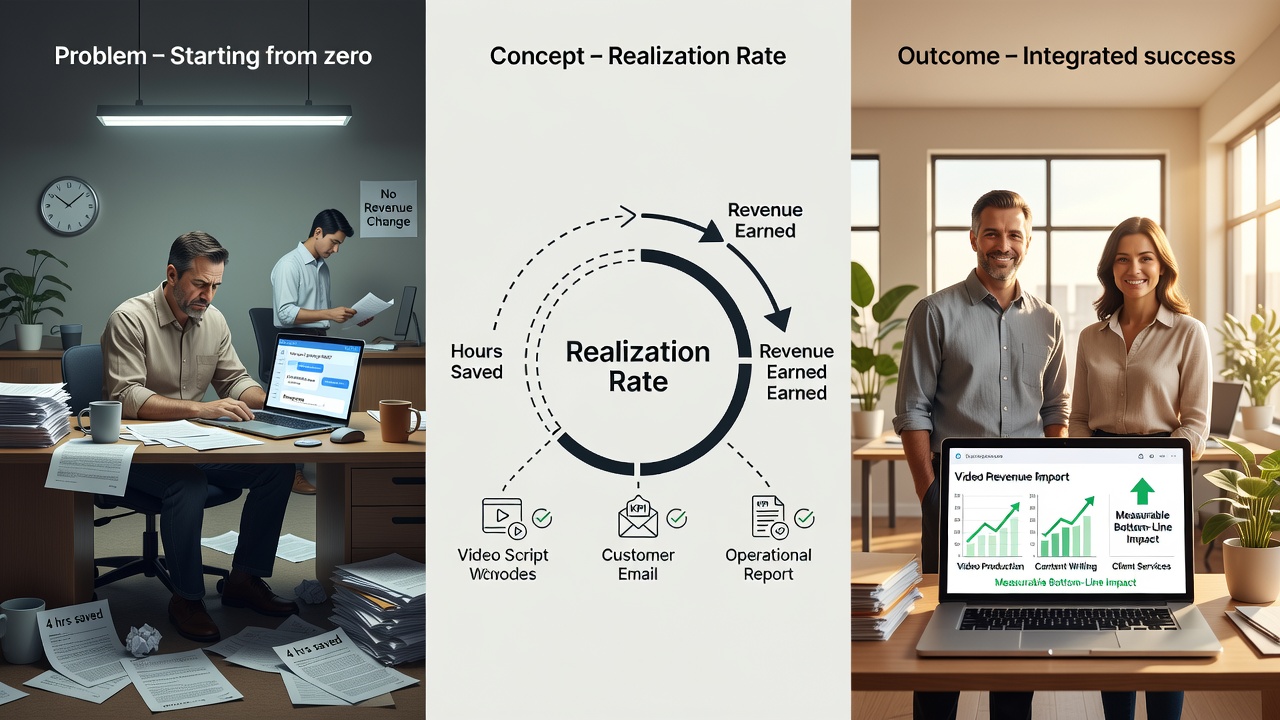
Bain introduced the term “Realization Rate” as the new competitive metric that separates leaders from laggards [2]. Realization Rate measures the percentage of expected value that actually reaches the income statement. Shifting measurement from “hours saved” to revenue-linked KPIs and quality-adjusted reallocation metrics closes the value gap.
McKinsey’s artificial intelligence Value Curve framework illustrates the same issue visually: deployment curves rise steeply while realized economics lag behind [1]. Organizations that treat artificial intelligence as a workflow transformation project rather than a tool-installation project achieve stronger returns. Wharton’s Adaptive Advantage Report confirms that workflow transformation in customer service, content, and operational analytics separates strong versus weak ROI performers [9].
SMB leaders can operationalize this by creating a simple monthly scorecard that tracks three columns: hours reallocated, quality metric (conversion rate, CSAT, error rate), and dollar impact. Reviewing this scorecard in 30-minute owner meetings keeps focus on outcomes rather than feature adoption.
High-Growth Areas with Published Benchmarks
Twelve workflows across four categories now carry published market figures and clear payback data. The Newmind artificial intelligence ROI Benchmark Guide 2026 aggregates 33 sources showing concrete returns in AI-assisted video production, writing and content creation, customer service automation, and operational analysis [8].
SMBs that focus first on these four areas outperform those chasing every new tool. Video scripts and short-form content that once required outside agencies can be produced internally with quality controls. Customer service chat and ticket routing reduce response times while maintaining satisfaction scores. Operational analysis dashboards surface cost leaks that were previously invisible. Each of these areas includes documented time-reallocation paths that tie directly to revenue or cost reduction.
Further validation comes from the UK Productivity Institute, which found that firms prioritizing these four domains achieved payback periods under 90 days when measurement protocols were followed [7].
Practical Examples for SMB Decision-Makers
Consider a 25-person e-commerce retailer. The owner pilots artificial intelligence writing tools for product descriptions and email campaigns. Instead of simply counting words produced, the team tracks three metrics over 45 days: percentage of saved writer hours moved to A/B testing and upsell sequence creation, quality scores from conversion-rate monitoring, and direct revenue per email send. The pilot shows a 22 percent lift in email revenue and a Realization Rate of 61 percent—well above the 38 percent average.
A 12-person professional services firm tests artificial intelligence video for client onboarding explainers. The workflow redesign moves two hours per week per consultant from slide creation to billable advisory calls. Quality is measured through client feedback scores, and downstream cost is tracked by comparing revision cycles before and after. The pilot delivers a 3.2x return on the artificial intelligence subscription within the first quarter.
A regional HVAC company automates first-line customer service with AI-assisted routing and knowledge-base answers. Saved agent time is reallocated to proactive maintenance outreach, which increases recurring contract revenue. The company replaces its adoption dashboard with a simple Realization Rate scorecard reviewed monthly by the owner and bookkeeper.
These examples share a common structure: every pilot begins with an explicit map from saved time to a revenue or cost line item, and every pilot runs long enough to measure quality and downstream impact. Expanding further, a 40-person logistics company applied artificial intelligence to route optimization analysis. The operations manager reallocated 6 hours weekly from spreadsheet maintenance to negotiating better fuel contracts, yielding a documented 9 percent reduction in variable costs within 60 days.
What to Do Next: A Five-Step Action Plan
Shift measurement from “hours saved” to Realization Rate and revenue-linked KPIs. Replace usage dashboards with a one-page scorecard that shows time reallocated, quality scores, and direct financial impact. Reference Bain, McKinsey, and Eldris guidance when building the template [2][1][5].
Map saved time to specific revenue-generating activities or cost reductions before scaling any pilot. Require every artificial intelligence use case to list the exact activity that will receive the freed hours and the expected dollar outcome [6][5].
Prioritize the twelve proven high-ROI workflows, beginning with artificial intelligence video, writing and content, customer service, and operational analysis. Use the Newmind benchmark guide as a starting checklist rather than experimenting with unproven tools [8].
Run controlled 30- to 60-day workflow-transformation pilots that track quality, time reallocation, and downstream financial impact. Limit scope to one function at a time so results remain attributable [9][7].
Apply the artificial intelligence Value Curve framework to decide where to deploy next. Only expand tools that demonstrate cost-effective economics at current scale; avoid chasing adoption metrics for their own sake [1].
Building Internal Capability Without Overwhelm
SMB owners do not need data scientists on staff. They need one clear owner—often the operations lead or office manager—responsible for the Realization Rate scorecard. Monthly 30-minute reviews with the owner and CFO or bookkeeper keep attention on revenue outcomes rather than feature lists. Training should focus on prompt patterns that protect brand voice and on simple A/B testing methods rather than model architecture.
Additional implementation detail includes creating a one-page pilot charter template that every department head completes before launch. The charter lists the target workflow, baseline metrics, reallocation plan, and success thresholds. This document becomes the single source of truth during the 45-day review.
Sustaining Momentum Through Quarterly Reviews
After the initial pilots conclude, schedule quarterly strategy sessions to evaluate which workflows have crossed the 50 percent Realization Rate threshold and merit expansion. During these sessions, compare actual dollar impact against the original pilot projections and adjust reallocation targets accordingly. This cadence prevents the common trap of declaring victory after the first 30 days and then allowing gains to erode.
A practical checkpoint is to require that any new artificial intelligence license purchase be justified by at least one active pilot already demonstrating positive Realization Rate. This policy keeps tool proliferation in check while ensuring every dollar spent has a clear path to measurable return.
Conclusion
Generative artificial intelligence can deliver meaningful time savings, but those savings only become revenue when measurement, workflow redesign, and disciplined pilots work together. SMBs that adopt the Realization Rate mindset and concentrate on the four high-growth areas—video, writing, customer service, and operational analysis—position themselves to capture far more than the 38 percent average. The tools are ready. The next step is to measure what actually reaches the bottom line and to reallocate every saved hour with intention.
The organizations that close the gap between reported hours and realized dollars will outpace competitors who continue to celebrate adoption numbers alone. Start with one focused pilot this quarter, track the three required metrics, and let the data guide the next move. Revenue impact is achievable; it simply requires the same rigor in measurement that was applied to the original artificial intelligence investment. By embedding these practices into routine operations, SMBs convert artificial intelligence from a productivity headline into a durable competitive advantage that directly strengthens cash flow and growth capacity.
Sources
- https://www.mckinsey.com/capabilities/quantumblack/our-insights/the-ai-value-curve-the-economics-of-applying-ai-to-existing-work
- https://www.bain.com/insights/realization-rate-the-metric-reshaping-enterprise-ai/
- https://the-decoder.com/frontier-radar-2-why-ai-productivity-gets-lost-between-benchmarks-and-the-balance-sheet/
- https://resources.rework.com/libraries/ai-transformation-strategy/time-saved-vs-revenue-impact-measuring-ai
- https://eldris.io/assets/reports/from-ai-time-savings-to-business-value.pdf
- https://londonresearchcentreformarketingai.org.uk/research/010-ai-productivity-economic-returns
- https://www.productivity.ac.uk/news/businesses-are-investing-in-ai-faster-than-they-can-make-it-pay-new-tpi-research-finds/
- https://newmindpartners.com/docs/guides/newmind-ai-roi-benchmark-guide-2026.pdf
- https://knowledge.wharton.upenn.edu/wp-content/uploads/2026/10/Wharton-GBK-AI-Adoption-Report-2026.pdf
- https://www2.census.gov/library/working-papers/2026/adrm/ces/CES-WP-26-25R.pdf


